

Jingyi and Valentine in inaugural issue of SNL
June 03, 2026
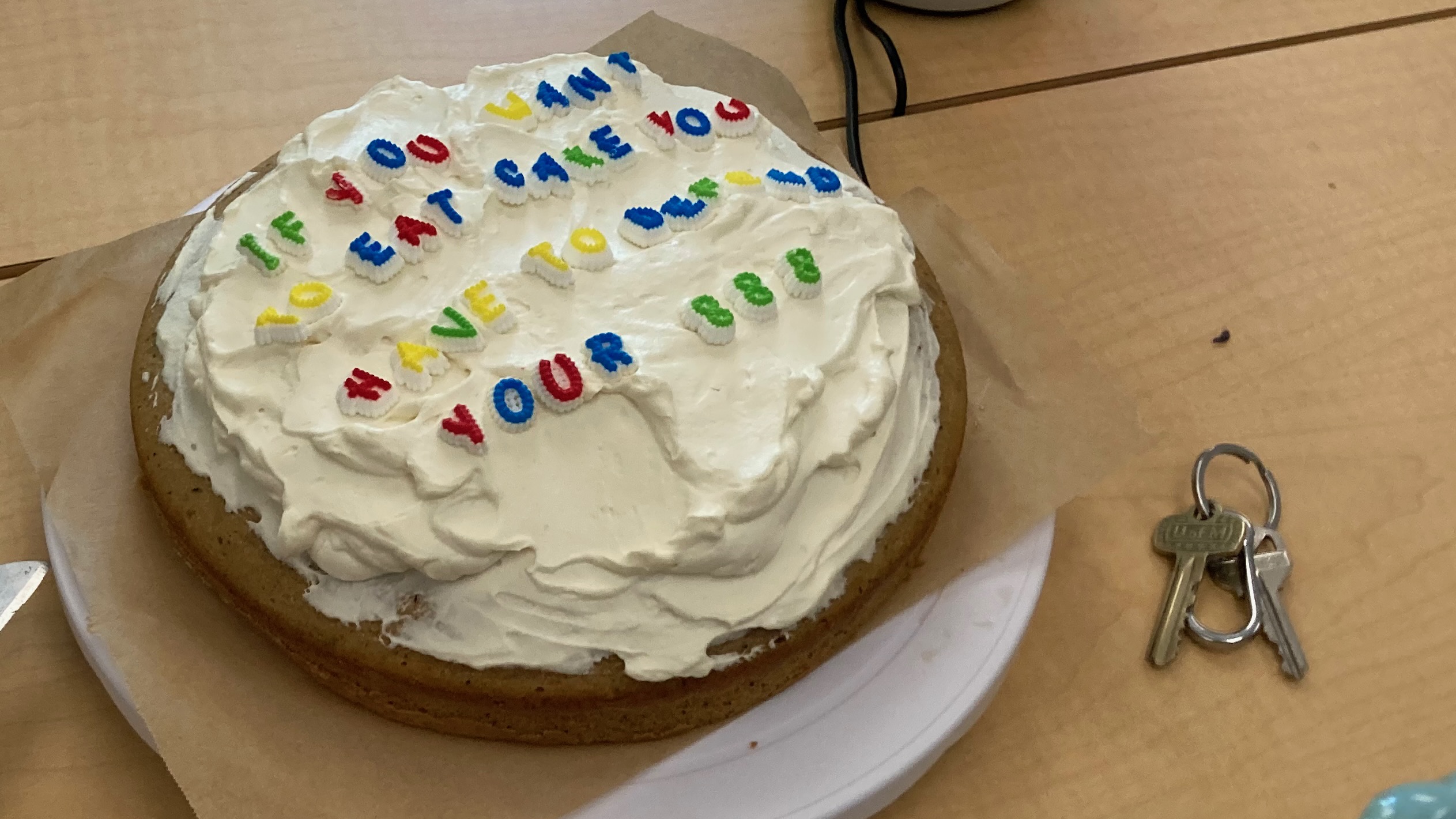
To launch a new journal, be pragmatic about anankastic conditionals.
Big congratulations to Jingyi Chen and advisor Valentine Hacquard, whose "Being pragmatic about anankastic conditionals," in pre-print form, has helped inaugurate a new journal, Semantics of Natural Language, "the scholar-owned and scholar-led intellectual successor to Natural Language Semantics, published with Open Library of Humanities under the auspices of LingOA," edited by Amy Rose Deal, Clemens Mayr and Florian Schwarz. Abstracted below, the paper from Jingyi and Valentine will also appear as Chapter 2 of Jingyi's dissertation, "Teleological modality in grammar and discourse," which she will defend on June 15. The committee includes, besides Valentine herself, co-chair Aron Hirsch, as well Alexander Williams, Fabrizio Cariani and Omar Agha, plus Yi Ting Huang representing the Dean of the Graduate School. After the defense, get ready to compare the claims from east of Lot W with those in Fabrizio's own forthcoming (and compatible) paper for Linguistics and Philosophy, "Anankastic conditionals and the default theory of reasons."
Standard accounts of modals and conditionals fail to derive the correct meaning of anankastic conditionals like ‘If you want to go to Harlem, you have to take the A train’, which seems non-compositional: the modal in the consequent seems to be restricted by the embedded complement of want (you go to Harlem), rather than by the whole antecedent (you want to go to Harlem). This has led to proposals for a special semantics for want (Condoravdi and Lauer 2016) or a covert purpose clause associated with teleological (goal-oriented) modality (e.g., von Fintel and Iatridou 2005). In this paper, we show that the apparent non-compositionality of anankastic conditionals is more general. It is just one species of what we call “harmonizing readings”, which also occur with other attitude verbs and modal flavors. We offer a pragmatic account that generalizes across modal flavors and attitudes. We argue that harmonizing arises when the meaning of the antecedent together with background assumptions gives rise to a modal inference that matches in flavor with the consequent modal. Our account predicts when harmonizing is possible and when it isn’t, without relying on lexical or syntactic idiosyncrasies.