

Skip to main content

Meaning Meeting - Fëdor Golsov / Russian bare NPs and the theory of reference resolution
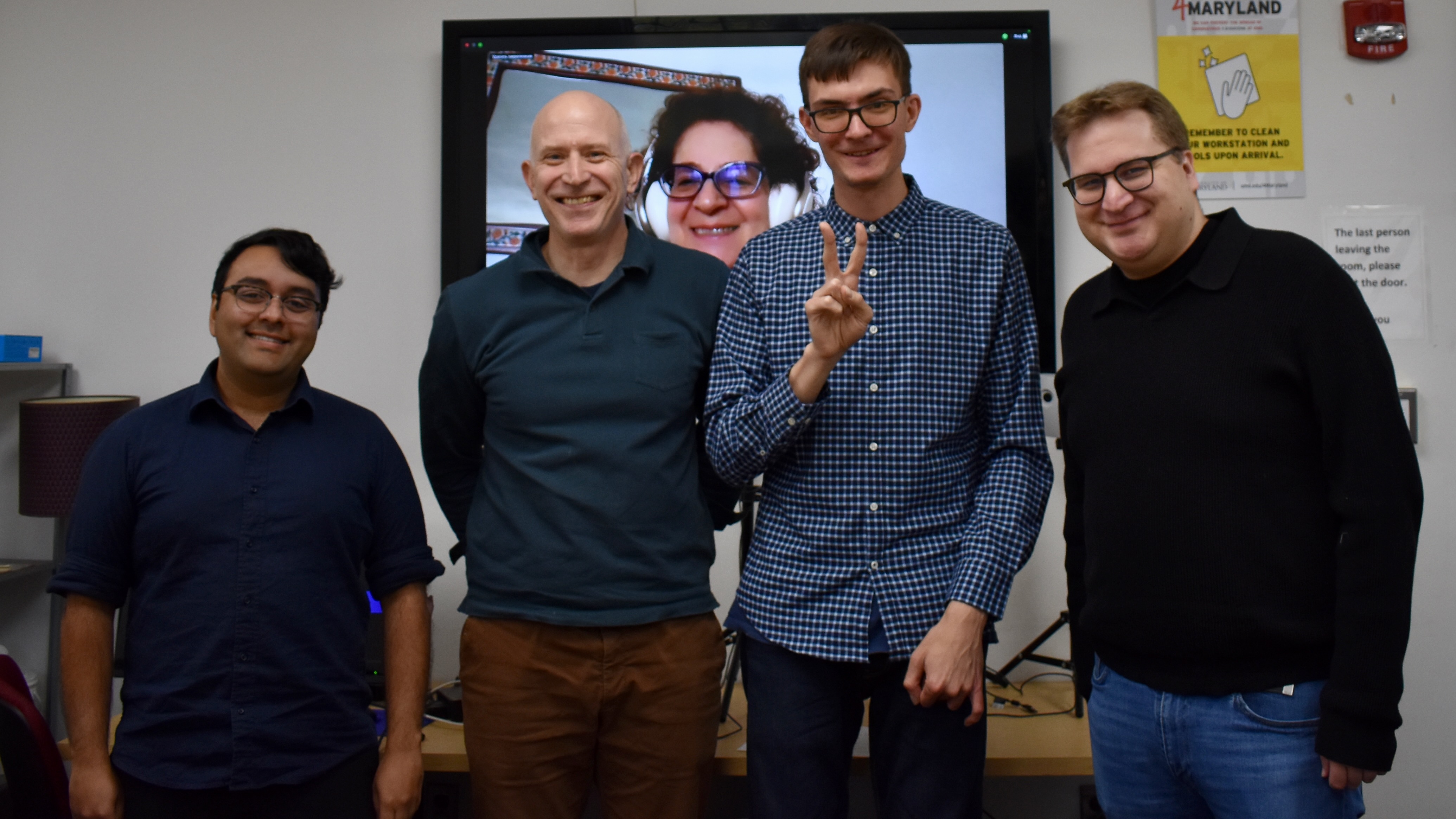
Four men standing in front of a large TV screen, smiling in a ceremonial pose, with a woman's head on the screen behind them, smiling together with them.

Meaning Meeting - Fëdor Golsov / Russian bare NPs and the theory of reference resolution

Linguistics | Philosophy Tuesday, February 24, 2026 12:30 pm - 1:45 pm Marie Mount Hall, 1108B

February 24 the Meaning Meeting features Fedya Golosov, sharing part of his dissertation work on "Russian bare NPs and the theory of reference resolution," abstracted below.


Bare NPs in Russian are neutral with respect to the parameter of (in)definiteness: they do not have a maximality presupposition and can introduce novel discourse referents, but they also do not have an anti-maximality requirement and can be used anaphorically. Surprisingly, however, whenever a chain of identical bare NPs appears within the same local context, they must co-refer. Why would that be?

At my talk, I will argue that this co-reference restriction is not surprising but is in fact what is predicted if we make the following assumption: the ability of an NP to introduce a new discourse referent is restricted the same way as ability of an NP to pick out a given discourse referent: it must be informationally unique (see Roberts 2003 and other works on anaphora resolution). In other words, we can explain the infelicity of anti-unique sequences of bare NPs by the general informational uniqueness constraint on the reference resolution, an extended version of the classic anaphora resolution constraint, as in (1).  

(1) Do not use an NP with the predicate N to introduce or pick out a discourse referent i in the local context c if there is another discourse referent j in c such that N(j) =1 in c.

I will also argue that a-NPs and some other indefinites can “cheat” this constraint via covert domain restriction, which is independently needed to account for their “exceptional scope” behavior.
 

Add to Calendar 02/24/26 12:30:00 02/24/26 13:45:00 America/New_York Meaning Meeting - Fëdor Golsov / Russian bare NPs and the theory of reference resolution

February 24 the Meaning Meeting features Fedya Golosov, sharing part of his dissertation work on "Russian bare NPs and the theory of reference resolution," abstracted below.


Bare NPs in Russian are neutral with respect to the parameter of (in)definiteness: they do not have a maximality presupposition and can introduce novel discourse referents, but they also do not have an anti-maximality requirement and can be used anaphorically. Surprisingly, however, whenever a chain of identical bare NPs appears within the same local context, they must co-refer. Why would that be?

At my talk, I will argue that this co-reference restriction is not surprising but is in fact what is predicted if we make the following assumption: the ability of an NP to introduce a new discourse referent is restricted the same way as ability of an NP to pick out a given discourse referent: it must be informationally unique (see Roberts 2003 and other works on anaphora resolution). In other words, we can explain the infelicity of anti-unique sequences of bare NPs by the general informational uniqueness constraint on the reference resolution, an extended version of the classic anaphora resolution constraint, as in (1).  

(1) Do not use an NP with the predicate N to introduce or pick out a discourse referent i in the local context c if there is another discourse referent j in c such that N(j) =1 in c.

I will also argue that a-NPs and some other indefinites can “cheat” this constraint via covert domain restriction, which is independently needed to account for their “exceptional scope” behavior.
 

Marie Mount Hall false